4. ISTP Variables
4.1. Variable Types
ISTP Guidelines divide all variables into three types, identified by the value of the VAR_TYPE variable attribute:
Data variables (
VAR_TYPE = "data") of primary importance (e.g., density, magnetic field, particle flux).Support_data variables (
VAR_TYPE = "support_data") of secondary importance (e.g., time and energy associated with particle flux).Metadata variables (
VAR_TYPE = "metadata") used for labeling dimensional data (e.g., a variable holding string array ["Bx GSE","By GSE","Bz GSE"] for labeling vector magnetic field).
Examples of data and support_data variables commonly found in ISTP datasets are shown below. They are mapped to their corresponding dimensions and sizes in CDF format (and could be in netCDF-4 and other structured file formats).
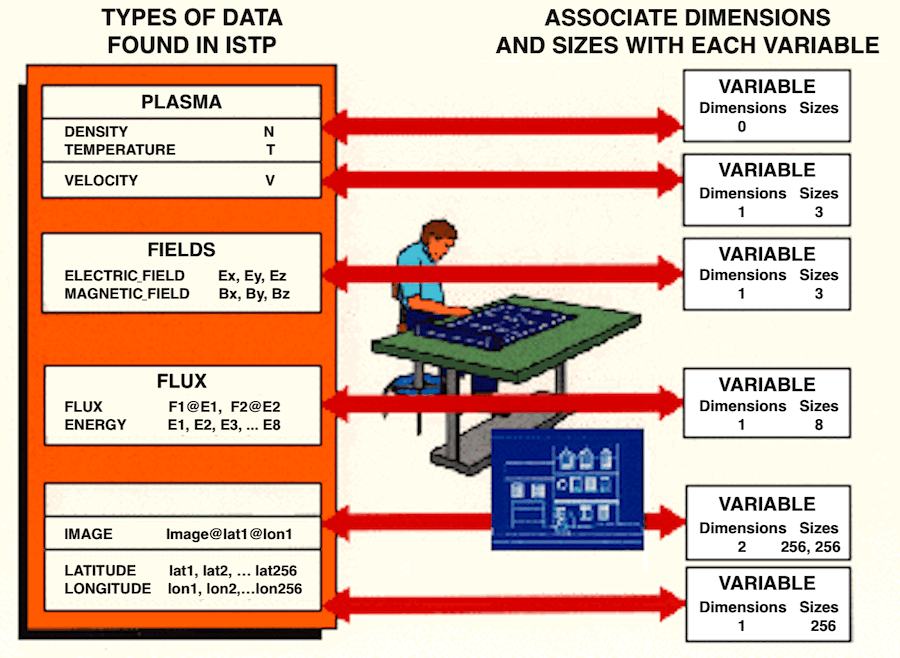
DENSITYandTEMPERATURE(data) are scalars; in CDF format they are associated with zero dimensions and no size. Note that in CDF format, time is associated with record (one record per timestamp), which is separate from variable dimensions.VELOCITY,ELECTRIC_FIELDandMAGNETIC_FIELD(data) are vectors, i.e., three orthogonal components in some coordinate system, stored as 1-D variables of size 3.FLUXhas values at eight energy channels.FLUX(data) andENERGY(support_data) are stored as 1-D variables of size 8.The
IMAGEarray (data) maps into a 2-D variable with sizes 256 and 256.LATITUDEandLONGITUDE(support_data) are 1-D variables of size 256, providing the necessary coordinates for theIMAGEarray.
Each ISTP variable type is defined with CDF (or netCDF-4) specifications and required attributes. Data variables also have attached variables for time and dependencies (support_data) and for labels (metadata). Support_data variables can be attached to data variables via, e.g., the data variable’s DEPEND_i attributes, with DEPEND_0 always pointing (by name) to a time variable. Metadata variables can be attached to data variables via, e.g., data variable’s LABL_PTR_i, UNIT_PTR, FORM_PTR, SCAL_PTR attributes.
An ISTP dataset usually spans over many files, over which the dataset definitions must remain static, meaning that variables cannot be added or removed, or have their data types, number of dimensions, dimension sizes, or variances within records and dimensions changed. When defining record or dimension variances of a variable, the whole dataset life, and not just a particular file, must be considered. Similarly, the variable dimensions must be defined with the maximum sizes expected over the dataset life, with currently unused values filled with the FILLVAL attribute value. There also must be no duplication of data over all dataset files, with all files seamlessly concatenating into one whole dataset.
(CDF-specific.) If extremely rare changes occur in the variable values over time, a CDF variable can be defined with record sparseness set to previous record. In this case, only records with changes need to be explicitly written into the CDF file, while reading any record will return the last explicitly written record before the requested one. Note that the first variable record in each CDF file still must be explicitly written with valid value. See the CDF User’s Guide for details on CDF variable sparse records. Alternatively, a rarely changing variable can have all records written, but variable compression should be enabled in this case. Variable compression should also be enabled for large size variables, while file-level compression is generally discouraged since reading is slower. Note that for efficient data access, time variables should never be compressed.
Each variable in a dataset must have a unique name that starts with a letter and can contain numbers, underscores, but no other special characters. Variable names are case sensitive, but the names must never be distinguished by case only. This enables broad support across many programming languages and analysis packages. Variable names should also carry sufficient information for initial understanding of their meaning by a dataset user and for clear distinguishing between different variables. Otherwise, the ISTP Guidelines do not prescribe a specific scheme for variable naming.
The variable names are used by CDF/netCDF-4 files internally but generally not visible to a user. FIELDNAM variable attribute is used for user-friendly name for a variable/parameter, while CATDESC holds longer and more complete variable description, particularly used for distinguishing between different variables. Additional information for a variable can be stored in the VAR_NOTES attribute. LABLAXIS/LABL_PTR_i are used for plot labeling, and they do not include units, which are stored in the separate UNITS attribute, also displayed in the plots.
4.1.1. Data Variables
Data variables are variables of primary importance (e.g., density, magnetic field, particle flux). Data variables are almost always of either a floating-point or integer data type, always time (record) varying, and can be a scalar or an array of values of up to 10 dimensions. Note that floating-point and integer data type variables are always defined as having one element at each variable value.
For a data variable, the following variable attributes are required:
DEPEND_0="Epoch"(variable of a time data types: CDF_TIME_TT2000, CDF_EPOCH, or CDF_EPOCH16)DISPLAY_TYPE("time_series","spectrogram","stack_plot","image","no_plot")VAR_TYPE="data"
Note that need for DEPEND_i (other than DEPEND_0) and either LABLAXIS or LABL_PTR_i depends on the data dimensionality and how it will be displayed.
See examples of data variable definitions and their displays. Additional display examples are available at CDAWeb.
4.1.2. Support_Data Variables
Support_data variables are variables of secondary importance holding numerical data, e.g., time or energy associated with particle flux. A support_data variable is always of either a floating-point or integer data type (including CDF time data types). It can be either time (record) invariant or time varying. An epoch (time) support_data variable attached to a data variable via DEPEND_0 attribute must have the same number of records as the data variable. If a support_data variable is attached to a data variable via DEPEND_i (i > 0), it must be of the same size as the corresponding dimension of the data variable. Also note that floating-point and integer data type variables are always defined as having one element at each variable value.
For a support_data variable, the following variable attributes are required:
DEPEND_0="Epoch"(if time varying)FILLVAL(if time varying)VALIDMIN(if time varying)VALIDMAX(if time varying)VAR_TYPE="support_data"
See examples of support_data variable definitions.
4.1.3. Metadata Variables
Metadata variables are variables of secondary importance holding strings, e.g., a variable holding array of strings for labeling magnetic field vector components. A metadata variable is always of a character type and is always time invariant if used to label a data variable. It can be time-varying only if it is NOT used as a label. If a metadata variable is attached to a data variable (via, e.g., LABL_PTR_i), it must be of the same size as the corresponding dimension of the data variable.
(CDF-specific.) A character data type variable must be defined with the number of elements equal to the maximum number of characters used in its values. For example, the number of elements is 6 in case of a variable holding an array of six-character strings ["Bx GSE","By GSE","Bz GSE"].
The following variable attributes are required:
See examples of metadata variable definitions.
4.2. Required and Recommended Variables
4.2.1. Epoch
(Required.) A support_data epoch (time) variable (a variable of one of time data types: CDF_TIME_TT2000, CDF_EPOCH, or CDF_EPOCH16) must be included and should be the first variable in each dataset. Each time-varying variable in a dataset depends (via DEPEND_0 attribute) on an epoch variable. Multiple epoch variables (e.g., Epoch_1s, Epoch_1m, or any other meaningful names) can be included in a dataset allowing time descriptions of variables with different time cadences. An epoch variable must be either monotonically increasing or decreasing, and it is strongly recommended that MONOTON variable attribute with either "INCREASE" or "DECREASE" value is included for each epoch variable. An epoch variable also should not contain FILLVAL values; instead, invalid epoch variable records, and also the corresponding data variable records, should not be included in the dataset.
CDF includes three time data types:
CDF_TIME_TT2000: nanoseconds since J2000 in Terrestrial Time as 8-byte signed integer; includes leap seconds and is well-defined; UTC conversion requires an up-to-date leap second table (last value is stored in CDF header as a check).
CDF_EPOCH: milliseconds since 0AD as 8-byte floating-point number; usually UTC but no leap seconds.
CDF_EPOCH16: picoseconds since 0AD as two 8-byte floating-point numbers; usually UTC but no leap seconds.
Note that for CDF_TIME_TT2000, CDF_EPOCH, and CDF_EPOCH16 data types, time encoding and decoding MUST be done using the dedicated CDF Library functions (also in the Python cdflib library).
Note that since CDF_TIME_TT2000 data type is precisely defined internally (as TIME_BASE = "J2000", TIME_SCALE = "Terrestrial Time", REFERENCE_POSITION = "Rotating Earth Geoid", UNITS = "ns"), it does not require explicit time attribute definitions, and it is strongly recommended for new datasets.
The ISTP Guidelines define the time value of a record as the center of the measurement period, if the measurement is not an instantaneous one. To describe time values that are different from the measurement period center, the epoch variable must include BIN_LOCATION attribute with a floating-point value between 0.0 (beginning of the measurement period) and 1.0 (end of the measurement period). Such epoch variable should also include description of the time position within measurement period in VAR_NOTES attribute and, preferably, also in CATDESC attribute. Alternatively, in order to completely describe the measurement periods, and especially in case of time varying measurement periods, DELTA_PLUS_VAR and DELTA_MINUS_VAR attribute pair can be used.
See examples of epoch variable definitions.
4.2.2. netCDF Time
(Required for netCDF.) netCDF-4 files can include the CDF time type variables, with CDF_TIME_TT2000 (stored as signed 8-byte integer) especially recommended, but will require using the CDF library time routines for conversion. Otherwise, netCDF-4 times are typically something like seconds from some specific time epoch, with UNITS = "seconds from 2000-01-01 UTC" or similar. In either case, the ISTP Variable Attributes for Time Documentation should be added.
4.2.3. Quality Flag
(Recommended.) Each dataset should include at least one quality or status flag variable which is time varying. Multiple quality/status flags should be included if data variables of different cadences are present in the dataset, or if the individual data variables of the same cadence require separate quality/status flags.
The dataset designer should consider defining quality/status flag variables as data (instead of support_data) if they are essential for correct interpretation of the primary data variables. Data (as opposed to support_data) variables are displayed in the list of dataset variables by the CDAWeb Display and Retrieval system. They are also always returned by the APIs accessing data from SPDF.
The quality flag may be a set of binary flags, with all zeros as the fully good case. UNITS variable attribute might be of the form "(0=good, 2=off, 4=cal)".
4.2.4. Time_PB5 (ISTP KP datasets)
(No longer relevant.) Time_PB5 is the second variable in an ISTP KP CDF dataset. It is not required for IACG or ISTP higher resolution or event data. Time_PB5 is a way of presenting time as an array of three integers: YEAR, DAY OF YEAR, and MSEC OF DAY. This allows for easy recognition of the time value when looking at the data, for instance in a data dump. See example of Time_BP5 and related variable definitions.
4.2.5. Post Gap Flag (ISTP KP datasets)
(No longer relevant.) At the May 1992 ISTP SWG it was decided that a record varying “Post Gap” Quality
Flag would also be included in each KP record. This I*4 Flag is included in every record and is defined in the following way: 0 - no gap occurred immediately prior to this record (thus most of the time this Flag would be set to 0); 1 - the gap occurred because the instrument was not in a mode that allowed for the production of KPs; 2 - the gap occurred because Level Zero or SIRIUS data were missing; 3 - the gap occurred because Level Zero or SIRIUS data were too noisy to compute KPs. Integer numbers above 9 can be used by the PI team to define other gap conditions, as required.
A variable similar to this is recommended for inclusion in CDFs to indicate real and substantial data gaps. The detailed definition of this flag should appear in the CDF metadata in the VAR_NOTES attribute.