6. Dictionary Keywords
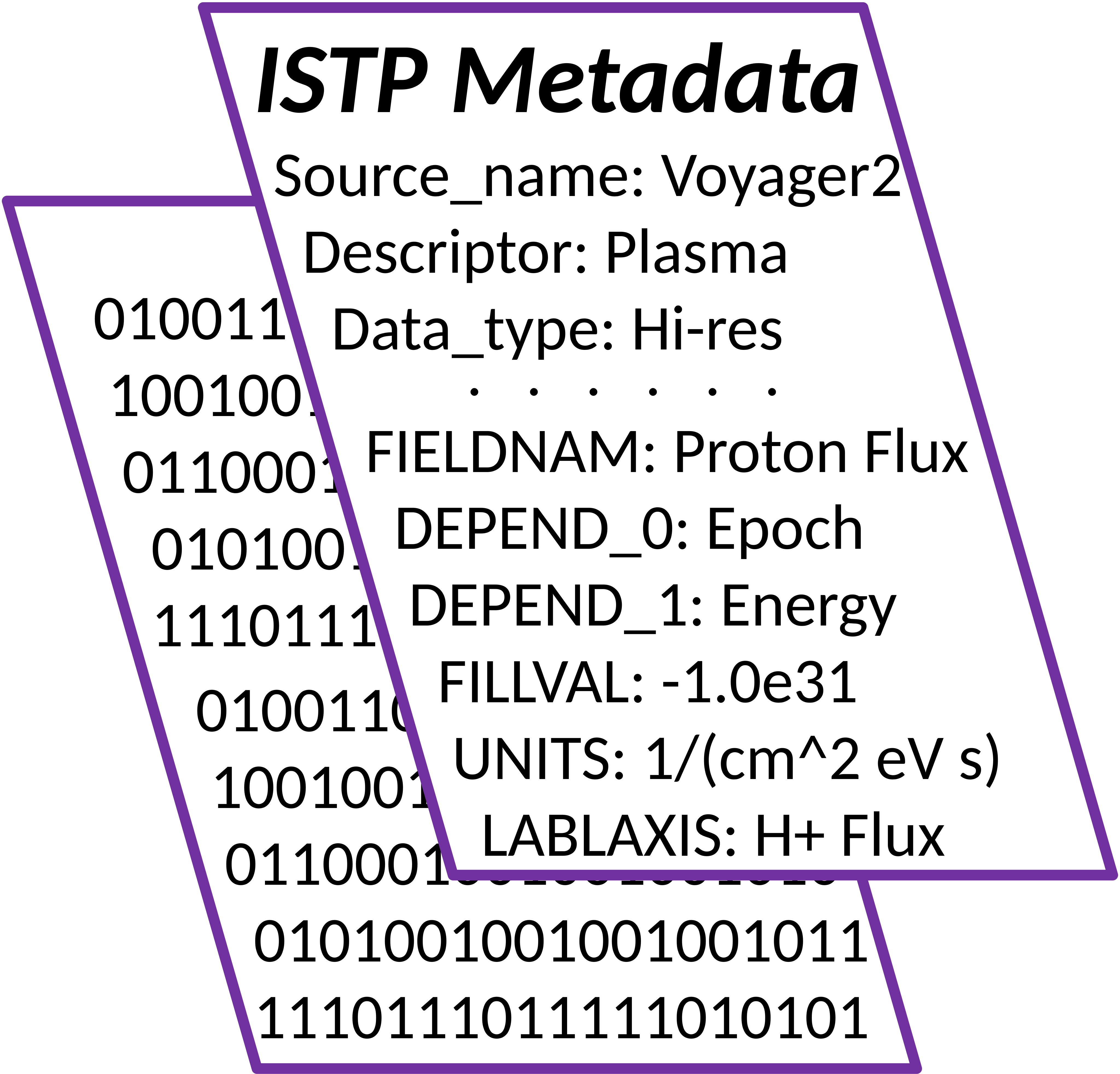
A project data dictionary contains information required to make the data independently useable to a wide community. The ISTP metadata format carries much (but not all) of the data dictionary information using a set of standard global attributes describing the overall data content and a set of standard attributes for each variable in the dataset. The variable attributes contain descriptions, variable types, minimum and maximum values, labels, units, time tags, and if required, dependencies, uncertainties, and offsets. However, there is little consistency in the variable names or descriptions to help other users of the data find and use the variables of interest.
6.1. SPASE Dictionary Keywords
See section below for use of the Original ISTP Dictionary Keywords with the DICT_KEY variable attribute. Alternatively, and preferably, DICT_KEY attribute can be used with values from the controlled lists of the Space Physics Archive Search and Extract (SPASE) data model, enabling both accurate description of parameters and full compatibility with the SPASE model. For compliance with the SPASE model requirements for Level 2 (L2) and higher level datasets archived at NASA SPDF, DICT_KEY attribute using SPASE controlled lists must be included for all data and support_data ISTP variables. DICT_KEY is not required for metadata variables.
See format and examples below (depending on the described parameter type in the SPASE model: Field, Particle, Wave, Mixed, or Support) for filling the DICT_KEY attribute string value. Note that the SPASE parameter type is independent from the ISTP variable type (data, support_data, or metadata, identified by the VAR_TYPE attribute value). Key:VALUE pairs in bold are always required, other Key:VALUE pairs are required if applicable. VALUE[_VALUE...] means multiple values are allowed, separated by underscores. If a parameter cannot be described in any other way, use DICT_KEY = “SPASE>Support>SupportQuantity:Other”.
In the DICT_KEY formats for various SPASE parameter types below, replace VALUE with a value from the linked list corresponding to the Key:
6.1.1. Field Parameter
Format:
DICT_KEY = “SPASE>Field>FieldQuantity:VALUE,Qualifier:VALUE[_VALUE...],CoordinateSystemName:VALUE,CoordinateRepresentation:VALUE”
Examples:
DICT_KEY = “SPASE>Field>FieldQuantity:Magnetic,Qualifier:Magnitude”
DICT_KEY = “SPASE>Field>FieldQuantity:Magnetic,Qualifier:Vector,CoordinateSystemName:GSM,CoordinateRepresentation:Cartesian”
6.1.2. Particle Parameter
Format:
DICT_KEY = “SPASE>Particle>ParticleType:VALUE[_VALUE...],ParticleQuantity:VALUE,Qualifier:VALUE[_VALUE...],AtomicNumber:VALUE[_VALUE...],CoordinateSystemName:VALUE,CoordinateRepresentation:VALUE”
Examples:
DICT_KEY = “SPASE>Particle>ParticleType:Electron,ParticleQuantity:NumberDensity,Qualifier:Moment”
DICT_KEY = “SPASE>Particle>ParticleType:Proton,ParticleQuantity:FlowVelocity,Qualifier:Vector_Moment,CoordinateSystemName:GSE,CoordinateRepresentation:Cartesian”
6.1.3. Wave Parameter
Format:
DICT_KEY = “SPASE>Wave>WaveType:VALUE,WaveQuantity:VALUE,Qualifier:VALUE[_VALUE...],CoordinateSystemName:VALUE,CoordinateRepresentation:VALUE”
Examples:
DICT_KEY = “SPASE>Wave>WaveType:Electrostatic,WaveQuantity:Intensity”
6.1.4. Mixed Parameter
Format:
DICT_KEY = “SPASE>Mixed>MixedQuantity:VALUE,ParticleType:VALUE[_VALUE...],Qualifier:VALUE[_VALUE...],CoordinateSystemName:VALUE,CoordinateRepresentation:VALUE”
Examples:
DICT_KEY = “SPASE>Mixed>MixedQuantity:AlfvenMachNumber”
6.1.5. Support Parameter
Format:
DICT_KEY = “SPASE>Support>SupportQuantity:VALUE,Qualifier:VALUE[_VALUE...],CoordinateSystemName:VALUE,CoordinateRepresentation:VALUE”
Examples:
For all Time/Epoch variables:
DICT_KEY = “SPASE>Support>SupportQuantity:Temporal”
For various other Support parameters:
DICT_KEY = “SPASE>Support>SupportQuantity:Positional,Qualifier:Vector,CoordinateSystemName:GSE,CoordinateRepresentation:Cartesian”
DICT_KEY = “SPASE>Support>SupportQuantity:Orientation,Qualifier:DirectionAngle.AzimuthAngle,CoordinateSystemName:GSE,CoordinateRepresentation:Spherical”
DICT_KEY = “SPASE>Support>SupportQuantity:DataQuality”
DICT_KEY = “SPASE>Support>SupportQuantity:Other”
6.2. Original ISTP Dictionary Keywords
We have extended the ISTP project data dictionary to include dictionary keywords that identify variables as being a certain type such as time or magnetic field regardless of the naming convention adopted by the investigators. Each variable has defined dictionary keywords (class and subclass) that are stored as a string value in its associated DICT_KEY attribute. The syntax for populating the Dictionary Keyword attribute DICT_KEY is class>subclass_subclass_subclass. See examples of use.
6.2.1. List of Class and Subclass Keywords
We provide a standard set of class keywords that include both sensor (science) and supporting class keywords and their meanings, to be used to categorize the data variables of primary interest to investigators. ISTP class keywords are restricted to the values shown below. Sets of subclass keywords, with each set used to modify one of the class keywords, are also adopted and listed with the associated information below. Lists of common subclass keywords, valid with any class keywords, can also be found below.
Sensor Class Keyword |
Description |
Subclass Keywords |
|---|---|---|
|
The variation of physical properties with direction, usually expressed as a ratio |
|
|
The rate of flow of electricity |
|
|
The mass per unit volume of a substance, or the number of items per unit volume |
|
|
The space surrounding an electric charge within which it is capable of exerting a perceptible force on another electric charge. The strength of an electric field at a given point is given in terms of the force exerted by the field on unit charge at that point |
|
|
The field of force surrounding a magnetic pole or a current flowing through a conductor, in which there is a magnetic flux |
|
|
The number of particles passing through a specified area or volume in a specified time interval (and possibly in a specified energy range or in a specified range of directions) |
|
|
The number of photons passing through a specified area or volume in a specified time interval (and possibly in a specified energy or wavelength range or in a specified range of directions) |
|
|
A location, distance, or direction with respect to some particular reference. The reference can be moving or fixed, such as the geographic coordinate system or a spacecraft body |
|
|
Electrostatic, magnetostatic, or gravitational potential, at a point in the field: the work done in bringing unit positive charge, unit positive pole, or unit mass respectively from infinity (i.e., a place infinitely distant from the causes of the field) to the point |
|
|
The rate at which energy is expended or work is done |
|
|
Force per unit area |
|
|
The degree or intensity of heat or cold as measured on a thermometric scale. Also the equivalent temperature corresponding to the energy of thermal motion of plasma particles, or the equivalent temperature as computed in radio measurements |
|
|
The rate of increase of distance traversed by a body in a particular direction (linear velocity) or the rate at which a body rotates about an axis (angular velocity). Speed is similarly defined with the omission of reference to direction |
|
Supporting Class Keyword |
Description |
Subclass Keywords |
|---|---|---|
|
The geometric figure formed by two lines diverging from a point or two planes diverging from a common line or the space between two such lines or surfaces |
|
|
The property of a system that is a measure of its capacity for doing work |
|
|
An entity that signals the occurance of an event, or that indicates a particular status of a spacecraft or instrument or software program. The flag can be a number, letter, or word, and may have any of a variety of encoded meanings |
|
|
The number of cycles completed by a periodic function in unit time |
|
|
A term or phrase attached by way of classification or characterization |
All other class keywords are also possible subclass keywords, |
|
A symbol or word, or a group of either of these, showing how many or what place in a sequence |
|
|
The quotient of one quantity divided by another of the same kind, and usually expressed as a fraction |
|
|
|
|
|
The origin (mission, spacecraft, instrument, ground observatory, or other observing platform) of the data in question |
|
|
The identity of a particle or class of particles in detail, such as common name, chemical name, mass, charge state, atomic number, atomic weight, degree of ionization, mass per charge, etc. |
|
|
The period between two events or measurements; a measurable interval, usually between a fixed reference (instant of time) such as 0 AD and the subject event or measurement |
|
|
An estimate of the lack of precision in an observed or calculated value |
All other class keywords are also possible subclass keywords, |
|
The distance from a particular point of a wave to that same point in the next oscillation cycle of the wave. Also a range of wavelengths, such as infra-red, visible, radio, x-ray |
|
6.2.2. Associated information: More on Class Keywords
The dictionary keywords and definitions (along with the other global and variable attributes) comprise the primary content of the ISTP project data dictionary. The class keywords were selected to be, as much as possible, a complete and orthogonal set. In the realm of space physics there are three broad classes of sensor data keywords: electric and magnetic field (DC values for vectors, AC values for power spectra), particle distributions (e.g., densities, flow speeds, flow direction angles, thermal speeds, temperatures, anisotropy, fluxes), images (e.g., remote sensing of the aurora, ionosphere and sun at various wavelength ranges measuring, e.g., electromagnetic waves, temperatures, pressures). In addition, there are time keywords, orbit/attitude keywords, and flags of various types (e.g., instrument mode). We choose the measured quantities such as magnetic field, density, temperature, to be the sensor (science) class keywords that are of primary science interest. Supporting keywords are of secondary science interest such as the energy or time at which a measurement was made, or the label or flag associated with a measured quantity. It is envisioned that the usage of the sensor (science) and supporting class keywords will be different. Sensor keywords make up a short, standard list that enables automated searching for data of interest at a fairly high level. Supporting keywords are at a lower level of interest, but may still be used for some types of searches. In the ISTP metadata model, every variable can have only one class keyword but any number of subclass keywords.
6.2.3. Common Subclass Keywords
The following lists of keywords are valid with any class keyword. Note that some species and wavelength subclass keywords are also considered to be common because they can be used in conjunction with several of the class keywords.
GENERAL Subclass Keywords — absolute, average, center, component, derived, instrument, interval, maximum, measured, minimum, mean, offset, spacecraft, vector, total
COORDINATE SYSTEM Subclass Keywords — cartesian, geographic, geomagnetic, GCI, GSM, GSE, HDZ, HGI, NEV, polar
SOURCE Subclass Keywords — electron, ion, proton, helium, nitrogen, oxygen, Z>3, neutral , particle, dust
WAVELENGTH Subclass Keywords — radio, IR, visible, UV, x-ray, gamma ray
6.2.4. Examples of Subclass Keywords
Source |
Instrument |
Variable |
DICT_KEY |
|---|---|---|---|
All |
All |
|
|
IMP 8 |
MAG |
|
|
IMP 8 |
MAG |
|
|
IMP 8 |
MAG |
|
|
IMP 8 |
MAG |
|
|
IMP 8 |
MAG |
|
|
IMP 8 |
MAG |
|
|
IMP 8 |
MAG |
|
|
DARN |
GBAY |
|
|
DARN |
GBAY |
|
|
DARN |
GBAY |
|
|
DARN |
GBAY |
|
|
Geotail |
EPIC |
|
|
Geotail |
EPIC |
|
|
Geotail |
EPIC |
|
|
Geotail |
EPIC |
|
|
Geotail |
EPIC |
|
|
Geotail |
EPIC |
|
|